I like these recycle bins

Seen at Changi Airport, Singapore.
No confusion over which colour is for which materials.
And more importantly, they're fun!
Seen at Changi Airport, Singapore.
No confusion over which colour is for which materials.
And more importantly, they're fun!
When Ummu Auni Afif shared some photos of the exchange and network room of the telecommunications company where she works, I viewed them with the interest of someone who read engineering (but didn’t really practice much of the technical stuffs learnt). Here’s a brief sharing of the industry I’m in, as promised to her.
The oil and gas industry is broadly divided into upstream and downstream. Upstream is the ‘getting the oil from under the ground’ part, from searching for potential area, designing and building the oil rigs, and the drilling operation itself. Once the oil out of the ground, it will go to a refinery, which is already downstream – ‘getting the oil to consumers’ part. Then the refined products will be shipped to terminals (or sometimes direct to customers) and then distributed to consumers from there. We’re more familiar with fuels being sold via retail stations since we pump petrol into our cars, but I sit in the commercial sector – my department sells fuels for use in boilers and other equipments in factories, transport companies, fishing boat, agriculture trucks and machineries, logging tractors etc.
The fuels price is dependent on published market rates, and in the case of Malaysia, we refer to Mean of Platts Singapore (have to subscribe to see the published numbers). In Malaysia, the price for certain sectors is regulated by the government using the Automatic Pricing Mechanism (APM). The difference between the pump price and the market price (simplistically put, there's actually a formula to this) will be paid to the oil companies by the Ministry of Finances. Other than the retail stations, the other sector that receives government subsidies are fisheries, transport companies that meet certain criterias and express boats (ferries in Sabah & Sarawak). There are quotas tied to each companies or organizations just as there are quota for diesel at each petrol stations, as a government measure to prevent subsidized diesel being (illegally) used in the commercial sector. The ministry who monitors this is MDTCA – Ministry of Domestic Trade and Consumer Affairs.
Now on to a current issue, most of us would already be aware of the recent oil spill (major leak!) on April 10, almost two months ago. Taken from here:
An explosion on the BP operated Deepwater Horizon oil rig killed eleven crew members on April 20, 2010, sparking the greatest environmental disaster in United States history. Current estimates put the amount of oil being discharged from the broken well at above 1,050,000 US gallons per day! There are over 400 different species of animals living in the area affected by the spill. 248 sea turtles and 33 dolphins have been found dead within the spill area.
 A bird covered in oil flails in the surf at East Grand Terre Island along the Louisiana coast Thursday, June 3, 2010. (AP Photo/Charlie Riedel)
Bekal dari rumah? Bukan. Bekas sahaja dari rumah, makanan dibeli di gerai Kak Zah. Just a little effort on my part to reduce the use of polistyrene containers. Waktu mula buat begini tahun lepas, rasa segan juga. Tapi sekarang dah ramai juga yang guna bekas sendiri bila nak tapau lunch.
Now in its fifth year, World Challenge 09 is a global competition run by BBC World News and Newsweek and supported by Shell, seeking to reward projects and businesses which bring economic, social and environmental benefits to local communities through grassroots solutions. The winner will receive a US$ 20,000 grant from Shell to invest in their project, and the two runners-up will each receive US$ 10,000.
Voting ends 13 November, so do go and vote. I have! I copied a brief description for each of the 12 finalists here below, but the videos and photos are even more interesting – check them out at the official website.
If I were to nominate a project from Malaysia (and there’s no reason why I shouldn’t), I’d nominate Yayasan Pembangunan Nur Hikmah. They use creative entrepreneurship ideas like Mangkuk Tingkat (they now have menu for ibu berpantang) and Tudung Myza (a collaboration with Myza Worldwide) and act as the link between the group in need of income (single mothers etc) and consumers to create win-win situations.
SOLAR SISTERS - INDIA
Barefoot Women Solar Engineers of Africa
These Barefoot Solar Engineers are bringing solar power to Africa’s countryside, lighting up the bush.
“They come as women, and they go back as tigers – they are so confident – oozing with confidence” Bunker Roy, Barefoot College
It’s hard to imagine that in parts of Africa south of the Sahara as little as 2% of the villages have access to electricity – that means no TVs, no microwaves, no fridges, and no electric light at night. Now the Barefoot College in India is training a small cadre of women to install solar panels in areas far away from any electricity grid. And Bunker Roy, the man behind the project, sees the engineers he has trained spreading the know-how across the continent. Roy is not satisfied with just brining light to Africa - he now wants to bring women from Latin America to his college for training.
EMISSION CONTROL - UNITED KINGDOM
Mootral
Our global addiction to meat is now influencing the climate, yet in Wales a new feed technology could help lead to a more sustainable meat industry.
“It’s simple, it’s scalable, it’s sustainable – so that’s why we believe Mootral is is a winner.” Michael Mathres, Mootral
The escalating world demand for meat and livestock products is contributing to potentially catastrophic climate change, especially in the fast-growing beef industry. The figures are not exact, depending on car usage, but it seems that a cow produces roughly the same amount of harmful greenhouse gases as an average car user – surprising when one considers there are twice as many cows in the world as cars. Now researchers in Cardiff have turned to nature, and the magical health properties of the humble garlic bulb, to develop a new feed additive that cuts the methane gas produced by the animals in half.
FUEL CELL - KENYA
Biogas as an alternative source of energy
A prison in Kenya is using inmate’s waste to power the kitchens and heating, reducing energy costs and improving the health of the prisoners.
“Since we got Biogasthere’s been a difference – there’s plenty of heat, but there’s no the smoke that there was before” Prisoner, Meru Prison
Meru prison in Kenya holds 9 times more prisoners than it was designed for. It is cramped, dirty and full of smoke from cooking fires. According to The World Health Organisation smoke from stoves and fires in homes causes around 1.6 million deaths per year worldwide. But a new biogas project, which uses the prisoners waste to power cooking and heating, has helped fix this problem – and it’s not just the prison inmates who are benefitting from this technology. Wherever there is a dense population of humans such as in, say a school or a hospital, biogas becomes economic. Skylink Innovators is a Kenyan company with big ambitions to stop the resource going to waste and saving, in the bargain, Kenya’s remaining woodland.
JIKO RESCUE - the Democratic Republic of Congo
Stoves for Survival
The endangered Mountain Gorilla population is getting a helping hand from a fuel-efficient ‘Jiko’ stove.
“Charcoal is a commodity that everybody needs, especially poor households, because there’s nothing else, and unfortunately 90% of Charcoal being used in Goma and Rwanda comes from Virunga National Park” Emmanuel de Merode, Virunga National Park
There are only 380 the Mountain Gorillas left in Central Africa, and their habitat is shrinking fast: one of their last refuges is Virunga National Park, but the Park and surrounding areas are rapidly losing their forest cover. The wood is used to supply towns like Goma in the Democratic Republic of Congo -- swelled by a refugee population -- with charcoal for cooking. To lessen the demand for charcoal, fuel efficient stoves are being manufactured locally and given to the people. It’s all part of a new approach to conservation which aims to show that conservation can benefit the poor as much as wildlife.
NO BEATING ABOUT THE BUSH - NAMIBIA
Cheetah Conservation Fund Bush Project
Namibian farmers, once the main threat to the Cheetah population, are now becoming their main protectors
“We’ve taken a problem and turned it around into a multitude of solutions” Laurie Marker, Cheetah Conservation Fund
Namibia is one of the last refuges of the remaining world Cheetah population. A quarter of all the remaining cats are found in Nambia. It is estimated their numbers globally have declined by over 90% in the last 100 years. A local thorn bush species is invading the savannah in the country, causing over US$90 million each year in lost revenue to Namibian farmers, whilst also destroying the native habitat of the fastest of the cats. Now the Cheetah Conservation Fund has pioneered a scheme to clear the thorn bush and turn it into cheap fuel briquettes. The project is creating jobs at the same time as helping to restore the hunting ground of the endangered cheetah.
FUNGI TOWN - UNITED STATES
BTTR Ventures
This innovative business turns the waste from coffee grounds into the ideal medium for growing gourmet mushrooms
“All the hard work starts paying off – you can see the mushrooms literally popping out of the substrate of the coffee” Nikhil Arora, BTTR Ventures
Did you know that less than 1% of all the coffee harvested each year ends up in your cup? Most of the coffee grounds finish as landfill. Two business school graduates in California, Nikhil Arora and Alejandro Velez, have spotted a money-making opportunity: instead of the grounds going direct to the tip, they collect the ‘waste’ and grow gourmet oyster mushrooms on pods in a humid warehouse. As Nikhil notes, “America is addicted to coffee” and around the world over seven million tonnes are produced every year – that’s a lot of waste. After the grounds are used up, they become compost for organic urban farms in the San Francisco area. Now the business looks set to expand as the health food superstore, 'Whole Foods' has begun to sell the gourmet mushrooms.
OLD SCHOOL THAI - THAILAND
Andaman Discoveries
The most genuine tourist experience possible in Thailand? Become a Thai villager for the week…
“I’ve been to Thailand many times and I’ve enjoyed their culture and their way of life and now it’s time I started giving back to them“ Jeannine Curd, Andaman Discoveries
The devastation of the December 2004 Tsunami killed nearly 300,000 people and caused $15 billion in damages. Over a million people were displaced from their homes. In Thailand, the tourist industry, which sees over 5 million visitors a year and over $7 billion come into the country is was badly affected. Andaman Discoveries has been working with local villages to bring tourists in to help with restoration. Some even take the option to do a ‘home stay’, living and eating with local families, to help with the reconstruction. It’s a new approach to tourism which places most emphasis on channelling goodwill and resources to protecting the local cultures, which so far have been unscathed by mass, package-holiday tourism.
LOVE 'N HAITI - HAITI
South-South Cooperation's Project
Could recycling waste and cleaning streets be the simple answer to Haiti’s massive social problems?
“We have moved from cutting down trees to transformation of waste into fuel briquettes“ Jean-Yves Jason, Mayor, Port-au-Prince
Haiti is an unfolding tragedy. The first independent country in the Caribbean is now the poorest in the Western Hemisphere. Many decades of mismanagement and bad governance have left over seven million Haitians with little hope that things will improve. But from the most unlikely place -- the crime- ridden and poverty stricken area of Carrefour Feuilles in the capital, Port-au-Prince – is an initiative that is cleaning up the streets and giving hope to the embattled citizens. A local action force is turning the waste littering the countryside into cheap fuel, at a stroke it’s bringing a kind of normality to the slum as well as meeting local energy needs.
NOTHING WASTED - INDONESIA
Danamon Go Green, Danamon Peduli Foundation
The traditional markets of Indonesia are getting a face-lift, and the organic fertiliser they now produce is giving farming in the area huge boost.
“The programme is very simple and easy – it uses simple technology, the raw material is here, available in the market, so it’s very cost-effective” Risa Bhinekawati, Danamon Go Green
Indonesia’s traditional markets are bustling and dirty, just as full of raw waste and rats as they are of store-holders and food. But the thousands of tonnes of waste generated in the markets contains nearly 90% vegetable materials and now, thanks to Danamon ‘Go Green’, they are being cleaned up and the waste turned into an organic fertiliser that is boosting local yields by over 30%. Not only do the local farmers benefit, but the levels of disease from spoiled produce are down and, most importantly, the markets are getting a long-awaited facelift.
A BRIGHT IDEA - SRI LANKA
Safe Bottle Lamp Project
One man’s mission to stop the horrific, and totally avoidable, injuries caused by unsafe kerosene lamps in Sri Lanka.
“If I win the World Challenge I can make and distribute 40,000 of these lamps, protecting over 80,000 people from these horrific burn injuries” Dr Wijaya Godakumbura, Safe Bottle Lamp Project
Despite an electrification programme, over 6 million people in Sri Lanka, nearly one third of the population, don’t have power. Many families rely on improvised lamps made from bottles to light their homes at night, but these can often spill and cause horrific injuries – figures suggest 300,000 people around the world die from accidental kerosene burns every year. Dr Wijaya Godakumbura, a surgeon who witnessed the terrible results of these accidents has designed a safe Lamp that can't roll over and cause a fire. To date, his small foundation has handed out about 775 thousand of the safe lamps.
OFF GRID AID - ISRAEL-PALESTINE
Comet-ME
Two Israeli physicists are helping Palestinian villages in the West Bank generate their own cheap renewable energy.
“The need was obvious – every household you go into, every person you meet, the need cries out to you“ Elad Orian, Comet-ME
In the politically volatile area of the occupied territories in the West bank are communities of Palestinian shanty towns - communities that live in darkness because for them an electricity grid is an impossible dream. But renewable technology such as solar and wind power could change that. Israel is one of the world leaders in solar power and two Israeli physicists, Elad Orian and Noam Dotan, are hoping to bring power to the desert by installing wind and solar technologies to help run lights and fridges for these impoverished people. Through their work developing sustainable power sources on the West Bank they are giving a light of hope, quite literally, to these off-the-grid neighbourhoods.
PATTERNS OF CHANGE - AFGHANISTAN
Afghan Hands
How the American high-end fashion business is creating a design for a better life for the widows of the decades of conflict in Afghanistan.
“The first time I bought them in they were shocked by the sheerness of these things… and they were shaking their heads, saying ‘These Americans – I don’t know what they want!’”
The conflicts in Afghanistan over the last 30 years have caused up to 2 million deaths – creating a generation of widows and orphans in the country. But Matin Maulawizada, whose own family escaped to the USA during the Soviet invasion in the 1980s, has returned to the country of his birth to help some of these widows. Arriving from the US bearing designs commissioned by a niche-market fashion house, his company, Afghan Hands, capitalizes on the skill of these women with a needle and thread and is now not only earning them an income, but teaching them literacy and numeracy as well.
From here.
Australian town in 'world-first' bottled water banThis piece of news interests me. In Malaysia, I don't think that many people are aware of the impacts of bottled water (or rather, the plastic bottles) to the environment. Since it is probably ‘difficult’ for us to install drinking fountains all around, I think it is a good idea to try and strike a balance, to start with. Let’s try to use reusable bottle as much as we can, but let the bottled water still be available in shops, for ‘just-in-cases’ (since there wouldn't be ample of drinking fountains). Every little helps. I’ve also read somewhere that drinking too much bottled (mineral) water and too little (boiled/filtered) tap water is not good for our teeth because the former lacks fluoride, which is ample in the latter. Hmm.. I’d better check this fact before publishing it. *go google* Ok here it is, some reference.
Hundreds of people marched through the picturesque rural town of Bundanoon to mark the first day of its bottled water ban by unveiling a series of new public drinking fountains, said campaign spokesman John Dee.
Shopkeepers ceremoniously removed the last bottles of water from their shelves and replaced them with reusable bottles that can be filled from fountains inside the town's shops or at water stations in the street.
MDTCA (I think this ministry got a new initial now but tak sempat nak check) has indicated as early as last year that the fuel RON92 will be replaced by RON95. Earlier this year, the implementation date was announced to be 1 September 2009. Effectively, there will be 2 gasoline grade available in petrol stations: RON95 and RON97. RON95 will be a controlled and subsidized product (price is expected to be RM1.75/liter on 1 September), while RON97 will be priced higher and ‘semi-floated’ (floor price imposed, prices to be reviewed and possibly approved by government, if I’m not mistaken). Because RON97 will be priced at about 20 sen higher than RON95, most users probably plan to switch to RON95, while RON97 will be seen a premium product.
But which car can and cannot use RON95? The following list is from the Motor Trader site. Please click the link to see the full list.  And I would like to reproduce their disclaimer here (to exempt Everyday Ice Cubes from liabilities too):
The following list has been compiled based on confirmations and unofficial discussions with some car companies. MTM Multimedia Sdn Bhd and its employees do not accept any liability or responsibility for any effect arising from use of this information. In some cases, even though an engine may be originally tuned to run on fuel with a certain RON, its age and condition may require a higher RON grade to avoid knocking. Some engines may also have knock sensors which can automatically adjust ignition timing if knocking is detected but this will result in some reduction in power output. If in doubt, do contact the car company dealing with your model.
The campaign, organised by WWF, is well-promoted, and being internet users, I’m sure you have heard about this. Earth Hour calls individuals and organisation to switch off the (non-essential) lights this Saturday 28 March 2009 for one hour from 8.30 to 9.30 pm (local time). I’m supporting this campaign and I hope you would, too. It's a reminder to me to reduce, reuse, and rethink not just this Saturday, but everyday, hopefully.
To me, Earth Hour is not about the electricity that is saved during that one hour per se. It’s more about creating awareness. “WWF Earth Hour a simple yet effective way for everyone to get involved in demonstrating they want action on climate change. Climate change often leaves individuals feeling totally overwhelmed by the scale of the problem but Earth Hour provides an opportunity for people of all ages to get involved” to quote a personality.
For more info, visit www.earthhour.org
Post-event: What I realised, during this symbolic event, is that something is easier to achieve when more people knows what’s going on and what exactly needed to be done. Well, it's not something we don’t already know, but just relating it back to our efforts to minimise our carbon footprints – it’ll be much easier when our individual efforts morphed to our concerted efforts.
Yesterday I watched a film at work. Before you get funny ideas, it’s actually screened at the big hall, organised by the company for the HSSE Week (HSSE stands for Health, Safety, Security and Environment). Aptly chosen for the theme ‘Protect Our Environment’, we watched An lnconvenient Truth. It is very good and well-presented; I was truly impressed. An lnconvenient Truth is a documentary film about global warming, presented by AI Gore. I can’t remember what he was like when he was the US Vice President, but after watching this film, I really admire his passion to champion this cause. The film, which is a little over an hour, presented a thesis that global warming is real, potentially catastrophic and caused by humans. The keynote presentation by AI Gore is alternated with clips of his stories of childhood, events that changed his worldview, travels (when giving presentations on global warming) etc; weaving scientific facts with the human connection. I absolutely recommend this film!
These are some of the points elaborated towards the end of the film:
There a 3 reasons that have sped up global warming:
i) population that is increasing exponentially – needing more food, energy etc,
ii) old habits + new technologies = drastic change to consequence, for example forests got cleared faster because of better machines, and
iii) mindset
There are 3 misconceptions regarding the global warming:
i) that it’s a theory rather than facts,
ii) that we have to choose between economy and the planet, and
iii) that the problem is too big, and there’s nothing we can do about it
We can do something about it. This is the Top Ten Tips taken from their official site. There’s actually much more ways on how we can reduce our carbon footprints.
- Change a light (use more energy-efficient bulbs and appliances)
- Drive less
- Recycle more
- Check your tyres
- Use less hot water
- Avoid products with lots of packaging
- Adjust the thermostat (or in our case, reduce the aircond temperature or use them less)
- Plant a tree
- Turn off electric devices (some device continued to draw electricity even when - they’re turned off, so unplugging helps too)
- Spread the word!
Here are some other little things that I pledge to do more (‘more’ being the operative word, ie not completely, but as best as I can):
- Refuse plastic bags when possible
- Use cups rather than disposable paper cups
- Use cloth rather than disposable kitchen/toilet towels
- Use containers rather than polistyrene foam when buying lunch
The following is copied and pasted from their site.
Carbon dioxide and other gases warm the surface of the planet naturally by trapping solar heat in the atmosphere. This is a good thing because it keeps our planet habitable. However, by burning fossil fuels such as coal, gas and oil and clearing forests we have dramatically increased the amount of carbon dioxide in the Earth’s atmosphere and temperatures are rising.
The vast majority of scientists agree that global warming is real, it’s already happening and that it is the result of our activities and not a natural occurrence. The evidence is overwhelming and undeniable.
We’re already seeing changes. Glaciers are melting, plants and animals are being forced from their habitat, and the number of severe storms and droughts is increasing.
- The number of Category 4 and 5 hurricanes has almost doubled in the last 30 years.
- Malaria has spread to higher altitudes in places like the Colombian Andes, 7,000 feet above sea level.
- The flow of ice from glaciers in Greenland has more than doubled over the past decade.
- At least 279 species of plants and animals are already responding to global warming, moving closer to the poles.
If the warming continues, we can expect catastrophic consequences.
- Deaths from global warming will double in just 25 years -- to 300,000 people a year.
- Global sea levels could rise by more than 20 feet with the loss of shelf ice in Greenland and Antarctica, devastating coastal areas worldwide.
- Heat waves will be more frequent and more intense.
- Droughts and wildfires will occur more often.
- The Arctic Ocean could be ice free in summer by 2050.
- More than a million species worldwide could be driven to extinction by 2050.
There is no doubt we can solve this problem. In fact, we have a moral obligation to do so. Small changes to your daily routine can add up to big differences in helping to stop global warming. The time to come together to solve this problem is now.
12 January 2007 – Flood in Johor, the second time in less than a month

15 January 2007 – Ice storm in the USA, harsh weather extends its grip

18 January 2007 – Storm in the Europe, worst in many years

21 January 2007 – Earthquake in the Molucca Sea of Indonesia, magnitude 7.3 Richter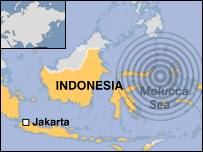
apakah ini tanda-tanda
dunia sudah lanjut usia?
bagaimana dengan kita
adakah sedang bersiap-sedia?


© Blogger template 'Minimalist G' by Ourblogtemplates.com 2008
Back to TOP


